





 [Credit: Getty. Erin Masters]
Give us your elevator pitch for The Gardens…
It’s a psychological mystery about a woman called Jess who receives a phone call one morning from a police detective who tells her that human bones have been found in the garden of the house where she grew up. It’s the news Jess has dreaded for three decades because it could confirm her worst fear – that her long-missing sister Nina is dead.
What inspired this novel?
I had a number of different ideas that all came together. I wanted to write a story set in the part of London where I’m from – even though I haven’t lived there for 20 years.
I also wanted to explore what the lasting effects would be for people who spent their childhood somewhere really damaging, in this case a closed-off commune. And I also wanted to write a story about how families cope in the devastating aftermath of a loved one going missing.
Did you take inspiration from any real cults?
Although I’ve always been fascinated by cults, I didn’t want it to be a “cult thriller”. But I did a lot of research into them when I started writing and also about communes. I was really struck by how these often seemingly quite idyllic places often appeal to people who are vulnerable and lonely and looking to belong somewhere.
I realised how easy it would be for these people to be exploited if they crossed paths with someone who had bad intentions and was in a position of power. So once I had an idea of the community and the person who led it, everything flowed from there.
Did you approach this book differently from your first novel, The Neighbours?
I think The Gardens is a much darker book in a lot of ways, and it has a more complicated plot, which was quite difficult to wrangle at times.
As with The Neighbours, I wasn’t sure of the ending until it crept up on me. I don’t really plot beforehand so I had to wait for my imagination to catch up and tell me what was going to happen and what the big twist was going to be.
What do you need when you sit down to write?
Once I’m in the flow of the story I can write wherever or whenever, although I do prefer a quiet room. But because of my day job – News Editor of Woman’s Day – I’m used to writing in a noisy open-plan office.
When it comes to editing, I like to be alone because that’s when you really have to unpick a story and put it back together again, and it’s a messy, often confusing process, which in my case involves lots of coffee, snacks, post-it notes and complaining.
What have you enjoyed reading recently?
I always have a book and an audiobook on the go. I just finished Erin Kelly’s The Night Stairs on audio, a gothic thriller set in a girls boarding school, and I’m currently reading Jessica Mansour-Nahra’s The Burn, which is an incredible thriller.
Visit Emma on Instagram here
Read on for an exclusive extract of The Gardens by Emma Babbington
Jess
After hearing the detective’s voicemail that morning, I had dressed and walked through the drizzly rain to the clifftop park and headed to my usual spot. The northern end of Coogee beach, looking out to the ocean across the vast Australian sky, where I always come when I want to be alone with my thoughts. But also, where I particularly like to come to think about Nina. To tell my sister all of my news, the good stuff and the bad.
The message, which had been left at two in the morning Sydney time, was from a Detective Inspector Sandhu in London. The woman had explained, her tone kind but efficient and businesslike, that human remains had been found by landscapers doing work at the back of 14 Willow Gardens where I had lived in the middle flat with my family for decades.
It was likely the remains had been there some time, perhaps decades, the detective continued. They’d been found in an area in the upper part of the shared back garden which had been covered with a large greenhouse until its recent removal.
‘Given that your sister, sorry, your half-sister, remains a missing person, we’d like to check if there’s a familial link.’ The detective had paused as if anticipating the adrenaline that would, at that very moment, be rushing through me with the shock of this news. She continued, ‘It would mean you providing a swab for a DNA comparison. But we can arrange for this to be done locally, in Sydney.’
At the cliffs, on that cool morning, I’d stared out at the slate grey water and replayed the detective’s words in my head as the wind whipped at my face. I was vaguely aware that I should probably be crying and wondered why I wasn’t. But honestly I was too numb for emotions at that point, having barely absorbed what I’d been told.
So, I just stared out at the grey, churning water, oblivious to the tourists as they moved around me, taking selfies, gesturing towards small flurries of spray, wondering out loud if it was one of the whales they’d heard pass through these waters in June.
It was only when a teenage girl nudged my side, and then quickly smiled her apology, that I’d felt a sudden weakness in my legs as my brain finally caught up.
There was a body buried in our London garden.
It could be Nina.
Missing since the summer of 1992 and now, perhaps, forever eighteen.
The possibilities of how my sister got there rushed through my thoughts. Some kind of inexplicable accident? Was that what had happened? How else does someone get buried underneath a layer of concrete and shed? My stomach roiled at the thought. At the horror of it.
That, after all this time and the searching and the questions and sadness and waiting, the answer had been there all along. In the back garden of the house where I grew up. Where Nina and I had grown up.
As the awful realisation thudded into place, I must have let out a small cry because another tourist’s head swivelled in my direction. An older woman, clearly alarmed.
I heard her words – ‘Is she okay?’ – as I turned from the Tasman and crossing the damp grass, broke into a slow jog. I managed to hold out until I was on the corner of my street. That’s when I bent over, hands on my thighs, as the emotion overwhelmed me and my body heaved with sobs.
So, what – you were there all along? How could you have been there all along, without us knowing? Just a few metres from where we carried on with living, carried on wondering. Carried on hoping you’d come back to us one day.
That evening when I called her back, DI Sandhu had got straight to the point.
‘The remains appear to have been there for quite some time,’ the detective explained, her tone softer and infused with a kindness I wasn’t prepared for. ‘We haven’t got a timeframe yet but other items found alongside the deceased suggest they were buried in the past forty years.’
The deceased.
Those two words would repeat over and over in my thoughts for the next forty-eight hours. The beat of them tapping out in time to my feet hitting the ground whenever I moved, turning more staccato as I sliced an apple and then in a kind of fever dream swirl on the long, seemingly endless flight to London.
‘What items were found?’ I asked, then ever polite, ‘If you’re allowed to say.’
‘I’m afraid I’m not.’ Her tone was heavy with sympathy. ‘Not yet, anyway.’
‘But you know it’s a woman?’
‘Yes, but nothing else at this stage. I’m very sorry, Jessica, but I should be able to give you more details in the coming days.’
‘I’m flying over,’ I said, not even realising I’d made this decision until the words left my mouth. ‘As soon as I can. I’ll give my DNA sample there, in person. I can come and meet you.’
‘Oh, I’m not sure there’s any need,’ the detective had begun but I cut her off.
‘If it’s my sister. If it’s Nina, then I need to be there. There’ll be things to … arrange.’ A pause. ‘I want to be there.’
When the call ended, I looked across the kitchen at Mum, who had been listening to the call which I’d put on speaker phone, her expression anxious one moment, grief-stricken the next.
‘Is it really her, do you think?’ she whispered.
I offered a gentle shrug. ‘I don’t know. But it could be a good thing, after all these years, if it is. At least we’ll be able to finally lay her to rest. Say goodbye properly.’
Mum stiffened a little and I knew she didn’t agree. She didn’t want to say goodbye to the possibility that her stepdaughter was still alive. And, of course, nor did I. But these platitudes felt like the ones you said at a time like this. They were all I had.
It is now sixty-eight hours later and I’ve travelled across oceans and continents and cities and islands, and I’m now blinking at the red-bricked façade of 14 Willow Gardens. Home for the first eighteen years of my life and now a crime scene.
It’s as familiar as the back of my hand: this grand Victorian terrace with a gable trim around the portico, high-pitched slate roof and the hydrangeas Mum planted years ago already in full bloom in the front garden bed. I’ve become used to the mostly mismatched, smaller houses of Sydney and standing before my childhood home I’m struck by how imposing, how grand, it seems. How charming.
I glance over my shoulder, giving a brief smile to my son who is waiting patiently for me to move beyond the front path. But my attention is momentarily diverted across the road, to the wrought-iron gate opposite which leads into the central, private residents’ garden this street wraps itself around. The other garden Nina and I spent so much time in.
Which framed my last ever glimpse of her, on Saturday, 29 August 1992.
I relive the moment in my mind’s eye. How my sister had turned to look up towards my bedroom window, given a cheery wave and then stepped into the garden and was gone. How in that moment, I had no idea it would be forever.
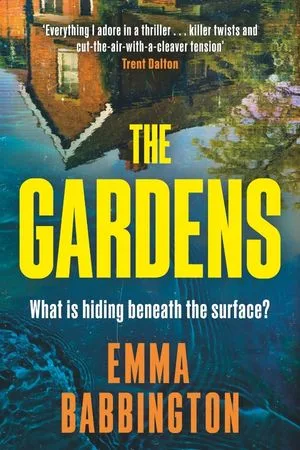
THE GARDENS ($34.99, HQ Fiction) is out now

